Where Dead Leggings Go: An Honest Guide to Recycling Worn-Out Activewear
Quick Answer: Worn-out activewear is one of recycling’s hardest cases - poly-elastane blends cannot be separated into reusable fibers at any meaningful scale, so honest disposal is a hierarchy, not a bin: repurpose what you can at home, send the rest to textile recycling programs or brand take-backs knowing most of it becomes insulation and stuffing rather than new leggings, offer clean stretchy pieces to animal shelters that accept bedding-adjacent donations (call first), and stop routing dead kit through donation bins - unsellable donations mostly burden charities. The bigger lever is upstream: buying less, better, and longer-lived.
Every activewear drawer eventually produces the pile: leggings gone sheer, sports bras with surrendered bands, socks past all dignity. The instinct is the donation bag, and for genuinely wearable pieces that instinct is right - but for worn-out kit it mostly exports the problem. The honest map of where dead activewear can actually go is shorter and less satisfying than the recycling logos suggest, which is exactly why it is worth knowing - both for this pile and for how you buy the next drawer.

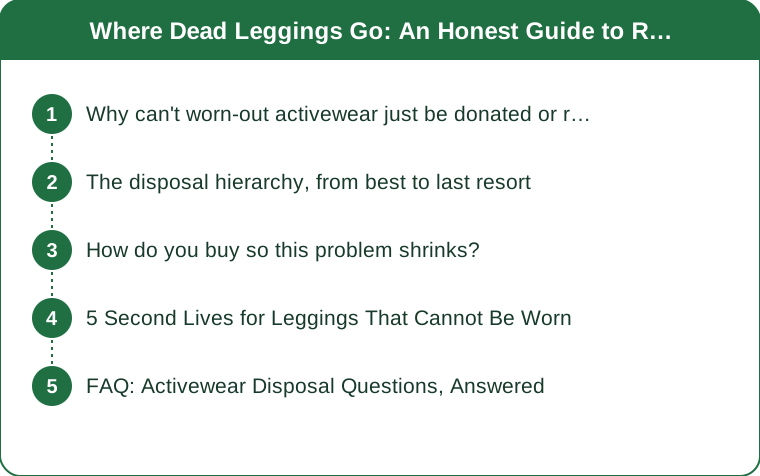
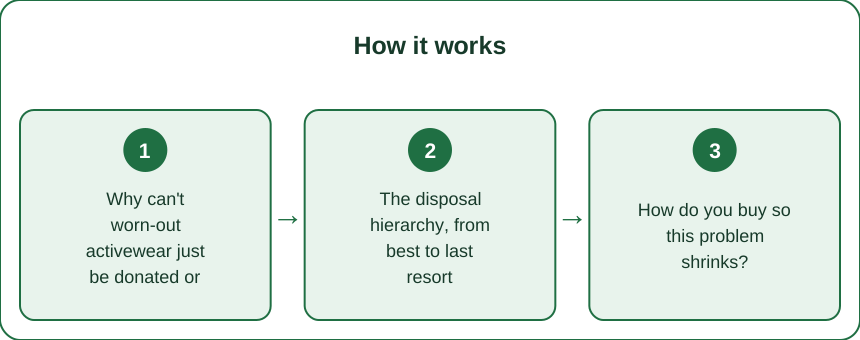
Why can’t worn-out activewear just be donated or recycled?
Two uncomfortable structural facts explain the whole problem.
Donation streams are resale streams. Charity shops exist to sell wearable clothing; they are not textile processors. Unsellable items - the sheer leggings, the dead bras - cost charities money to sort and dispose of, or get baled into the global secondhand trade, where the lowest grades ultimately become someone else’s landfill problem, frequently in countries with the least waste infrastructure. The donation bag feels virtuous precisely because the consequences happen out of sight. The working rule is simple and worth adopting permanently: donate only what you would hand to a friend. Wearable activewear with life left - absolutely, donate it. The worn-out pile needs a different door.
Blended synthetics are recycling’s hardest case. The fabric that makes activewear brilliant - polyester or nylon fused with elastane for stretch - is the same fabric that defeats recycling. Fiber-to-fiber recycling requires clean, separable material streams, and elastane is chemically entangled with its host fiber; no commercially scaled process today un-blends a legging back into virgin-quality fiber. Add dyes, coatings, foam cups, clasps, and mixed trims, and a sports bra is less a recyclable object than a small engineering compound.
So most textile recycling is honestly downcycling. Collected synthetics are largely shredded into shoddy - stuffing, insulation panels, carpet padding, acoustic filler - a genuinely better fate than landfill, but a one-way trip down the value chain, not a loop. And the recycled polyester in new leggings almost always comes from plastic bottles, not old clothes - a fine input with an awkward truth attached: it borrows from the bottle-recycling loop rather than closing a textile one.
None of this means disposal choices are pointless - it means they are triage. The hierarchy in the next section is ordered by what genuinely happens downstream, not by what feels best at the drop-off.
The disposal hierarchy, from best to last resort
Work the pile top to bottom; each tier catches what the one above cannot.
Tier 1: Repair and keep serving. A popped seam, a failed drawcord, a small hole - five-minute fixes with a needle or a repair shop visit that return months of service. Repair is the only option on this list that fully preserves the garment’s value, which is why it outranks everything. The honest test: if the fabric itself is sound and one component failed, repair; if the fabric is done - sheer, crunchy, dead elastic - move down the list.
Tier 2: Repurpose at home. Sound-but-unwearable stretch fabric is genuinely useful material: cleaning rags that outperform cotton for dusting, drawer organizers, plant ties, packing padding. This tier absorbs a surprising share of the pile at zero cost - details and ideas in the next section.
Tier 3: Brand take-back and textile recycling programs. Several activewear brands run take-back schemes (mail-in bags or in-store bins, sometimes with store credit), and most cities have textile recycling drop-offs or collection events that explicitly accept worn-out items - the key phrase to look for, since it separates true recyclers from resale collectors. Go in with calibrated expectations: your leggings will most likely become insulation or stuffing, and that is still a real win over landfill. Two minutes of checking what the program says happens downstream is worth doing - the good ones tell you.
Tier 4: Animal shelters, with a phone call first. Many shelters welcome clean soft textiles for bedding and cage lining - and many others are drowning in them, or cannot use items with elastic bands and clasps. One call decides it. Wash everything first; a shelter is not a laundry.
Tier 5: The trash, honestly. Truly contaminated, mildewed, or unusable pieces - and whatever the tiers above rejected - go in the bin without ceremony. Never the curbside recycling cart: textiles jam sorting machinery and contaminate loads, making them one of the worst wish-cycling categories there is. A worn-out sock in the trash is not a moral failure; the failure happened years earlier, at manufacturing scale - which is what the buying section is about.

How do you buy so this problem shrinks?
The disposal pile is downstream of purchase decisions - and the upstream lever is ten times the size of the downstream one.
Buy fewer, better, and rotate. The math is boring and decisive: three quality pairs in rotation, each resting between wears, outlast six cheap pairs bought across the same period - while producing half the eventual pile. Rotation matters independently of quality, too: elastane recovers between wears, so the same pair worn daily dies faster than it would sharing the load. Cost-per-wear, not price tag, is the sustainability metric that also happens to be the budget metric.
Let durability drive the checkout. The features that extend a garment’s life are checkable at purchase: dense knit (hold it to the light), doubled waistbands, flatlock seams, reinforced stress points, and gusset construction in leggings. The same features that survive squats survive years - durability and performance are mostly the same shopping list.
Prefer simplicity where performance allows. A 100-percent-polyester loose tee is far closer to recyclable than any blend; fewer trims, fused details, and mixed panels mean fewer dead-ends at end of life. Stretch garments will keep needing elastane - that is the honest trade for squat-proof leggings that fit - so spend the simplicity where stretch is not the point: layers, tees, shorts, bags.
Buy secondhand where the category allows, and care like it matters. Lightly-used outer layers, tanks, and shorts thrive on resale platforms - and every secondhand purchase is a new-manufacture avoided. Then the care habits that double lifespan across the board: cold wash, mesh bags, no softener, air dry. (Both are covered in depth in our other guides - here they matter as pile-prevention.)
And close your personal loop annually. One drawer audit a year: wearable-but-unworn pieces exit to donation or resale while they still have value - the single best time to donate is before you stop wearing something, not three years after - and the true dead pile runs the hierarchy. A drawer that gets audited yearly never produces the archaeological pile that makes this whole problem feel unmanageable.
5 Second Lives for Leggings That Cannot Be Worn
1. The best dusting rags you will ever own. Cut into hand-sized panels, legging fabric grabs dust electrostatically, never sheds lint, washes forever, and does not scratch - better than any purchased microfiber for screens, blinds, baseboards, and the car dashboard. One dead pair yields a year of rags; the knit does not fray, so no hemming, just scissors.
2. Garden ties and plant slings. Rings cut across a legging leg make stretchy loops that tie tomatoes and young trees to stakes without cutting into stems - the stretch is the feature, flexing with growth and wind where twine bites. August gardens are exactly the season for this one; a single leg supports the whole tomato patch.
3. Packing and storage padding. Legging sleeves slide over bottles, glasses, and picture frames for moves and storage; waistbands become wide bands that keep rolled rugs, yoga mats, and cables coiled. The fabric that protected your knees in lunges protects the stemware in the attic - same job description, honestly.
4. Hair ties, headbands, and scrunchie filling. Cross-cut rings from the leg are instant soft hair ties that do not crease; wider tubes become workout headbands; and anyone with a sewing machine can case old legging strips inside fresh fabric as scrunchie cores. The fiber spent years holding tension - it is genuinely good at this.
5. The car and gym-bag emergency kit. One panel in the glovebox (windshield fog, spills, checking oil), one in the gym bag (bench wipe-downs, an emergency sweatband, a soft pouch for glasses). Dead activewear makes the best supporting-cast textile in your life precisely because it owes you nothing and washes endlessly.
The honest note on all five: repurposing delays disposal rather than deleting it - which is exactly the point. A legging that serves three extra years as rags and plant ties tripled its service life, and the trash it eventually becomes is the same trash it would have been in August.
FAQ: Activewear Disposal Questions, Answered
Can worn-out leggings go in a clothing donation bin?
They should not - bins feed resale streams, and unsellable items cost the charity money or get exported down the secondhand chain to become someone else’s waste. Donate what a friend would happily wear; route the genuinely worn-out pile to textile recycling that explicitly accepts damaged items, or through the repurpose tier first.
What actually happens to clothes in brand take-back programs?
Wearable returns are typically resold or passed to reuse partners; worn-out synthetics are mostly downcycled - shredded for insulation, padding, and stuffing. Genuine fiber-to-fiber recycling of blended activewear remains rare and small-scale. Take-backs are still worth using: downcycling beats landfill, and programs that offer transparency about downstream fates deserve the business over ones that do not.
Are leggings made from recycled polyester actually better?
Modestly, honestly: recycled polyester (usually from bottles) carries a meaningfully lower production footprint than virgin polyester, and supporting it signals demand. It does not make the garment recyclable at end of life - the elastane blend problem is unchanged - and it borrows material from the bottle loop. Treat recycled content as a genuine plus, and durability as the bigger one.
How do I recycle sports bras specifically?
Bras are the hardest item in the drawer - foam cups, clasps, channels, and blends in one small package. The route: remove what you can if repurposing (foam cups make decent padding inserts elsewhere), send the rest through textile recycling or take-back programs that accept damaged items, and know that a few specialty bra-recycling initiatives exist and rotate availability. Wearable bras with life left, as ever, do the most good donated while still genuinely usable.
TL;DR:
- Donation is for wearable kit only - worn-out donations mostly burden charities or export waste.
- Blended synthetics cannot be un-blended: textile recycling of dead activewear is honest downcycling into insulation and stuffing, and that still beats landfill.
- Run the hierarchy: repair, repurpose at home, take-back and textile programs, shelters (call first), then trash - never the curbside cart.
- Dead leggings earn second lives as rags, plant ties, packing padding, hair ties, and emergency cloths.
- The real lever is upstream: fewer, better, rotated, cared-for, and audited annually while pieces still have donation value.
There is no perfectly clean exit for a dead legging - the industry has not built one yet. What you control is the length of the life before the exit, and the honesty of the route through it. That turns out to be quite a lot.
See It in Motion
Seen here: Super High Waist Embossed Yoga Leggings with Inner Pocket — shop it on bubblelime.com
Keep Reading
This article is for general informational and styling purposes only. Fit, sizing, and product availability may vary.