Five Signs an Activewear Sustainability Claim Is Real
Quick Answer: Real claims are specific, measurable, and third-party verified. Look for a named certification with a licence number, a stated percentage rather than a vague adjective, information about the whole garment rather than one component, a takeback or repair programme that actually exists, and honest acknowledgement of what the brand has not solved. Anything using words like eco, green, or conscious without a number attached is marketing.
Here are the five signs, each with what it looks like on a real product page.

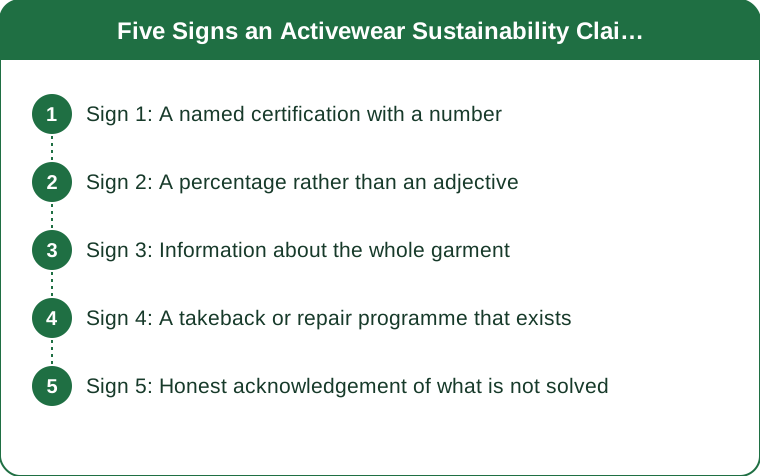
Sign 1: A named certification with a number
What to look for: a specific certification name, and ideally a licence or certificate number you can look up.
The meaningful ones in activewear are GRS (Global Recycled Standard) and RCS (Recycled Claim Standard) for recycled content, OEKO-TEX Standard 100 for chemical safety in the finished garment, bluesign for the manufacturing process and chemical inputs, and Fair Trade Certified or WRAP for labour conditions.
What a weak version looks like: a logo with no number, a certification named in a footer but not attached to any specific product, or a made-up-sounding standard that turns out to be the brand’s own internal programme.
Why it matters: these standards involve third-party auditing of the supply chain. GRS in particular tracks recycled content through every processing stage, which is what prevents a supplier claiming recycled polyester that is not. A brand paying for that audit is spending money on something invisible to the customer, which is itself the signal.
The check: most certifying bodies have a public database. Searching the brand name takes about thirty seconds and settles the question.
Sign 2: A percentage rather than an adjective
What to look for: ‘made with 78% recycled polyester’ rather than ‘made with recycled materials’.
The number is doing the work. ‘Contains recycled materials’ is technically satisfied by 1%. A brand with a genuinely high recycled content states it, because it is the strongest thing they have to say.
What a weak version looks like: ‘made with recycled fabrics’, ‘contains sustainable materials’, ‘eco-conscious blend’. All of these are unfalsifiable, and unfalsifiable claims are chosen deliberately.
The specific trap in activewear: a legging described as recycled where the recycled content is the main body fabric and the waistband, elastic, and thread are all virgin. Since the elastane is usually virgin regardless — recycled elastane is still rare and technically difficult — a 78% recycled figure is often close to the practical ceiling for a stretch garment.
Which means high honesty looks like a moderate number. A brand claiming 100% recycled on a stretch legging is either counting only one component or is not being straight with you. A stated 75-85% with an explanation of what the remainder is, is the shape of a real claim.

Sign 3: Information about the whole garment
What to look for: the brand talking about dye, finishing, packaging, and shipping — not only the fibre.
Fibre is the part everyone talks about because it is the easiest to change. Dyeing and finishing are frequently the larger environmental impact, consuming enormous quantities of water and energy and producing the majority of the chemical load in textile manufacturing. A brand that has done work here will say so, because it was hard and expensive.
What to look for specifically: mention of low-water or dope dyeing, closed-loop water systems at the dye house, PFAS-free water repellency, or bluesign-approved chemical inputs.
What a weak version looks like: an entire sustainability page about recycled bottles with no mention of anything else in the process.
Packaging is a smaller but revealing signal. Plastic-free mailers and no individual polybags cost more and are visible to the customer. A brand doing the invisible work usually does the visible work too, and the reverse is not reliably true — plenty of brands do only the visible part.
And shipping matters more than most pages admit. Air freight has a dramatically higher footprint than sea. A brand stating that it ships by sea is telling you something real about its planning, because sea freight requires longer lead times and more inventory risk.
Sign 4: A takeback or repair programme that exists
What to look for: a working page with instructions, an address, and terms — not a paragraph describing an intention.
Repair is the strongest signal in the entire category. A brand offering to repair a garment is making a claim about durability that costs it money if the claim is false. It is the only sustainability commitment that is genuinely self-verifying.
Takeback programmes vary in seriousness. A genuine one tells you what happens to the garment — resold, downcycled into insulation, or mechanically recycled — and does not pretend that textile-to-textile recycling of a blended stretch fabric is currently easy, because it is not.
What a weak version looks like: a recycling programme that exists as an announcement, a partner logo with no process described, or a takeback that turns out to be a discount voucher for buying more.
The resale signal. A brand running its own resale platform has a direct financial interest in its garments lasting, which is a genuinely aligned incentive and one of the more meaningful structural signals available.
The check: click through to the actual programme page. If it takes more than two clicks to find any operational detail, the programme is probably thinner than the announcement suggested.
Sign 5: Honest acknowledgement of what is not solved
What to look for: a brand saying plainly what it has not fixed.
This is counter-intuitive and it is the most reliable signal of the five. Nobody has solved activewear sustainability. Stretch fabrics shed microfibres. Elastane is not currently recyclable at scale. Blended fabrics are extremely difficult to separate. Synthetic performance fabrics are petroleum-derived even when recycled.
A brand that says all this is telling you it understands its own supply chain. A brand whose page reads as an unbroken series of achievements either does not know or is choosing not to say.
What honest looks like in practice: publishing a materials breakdown with the virgin content stated, acknowledging microfibre shedding and recommending a filter bag, naming which factories are audited and which are not yet, or publishing a target with a date and a previous year’s actual figure to compare against.
What a weak version looks like: aspirational targets for 2030 with no baseline, no interim milestones, and no statement of current performance.
The practical test that covers all five: read the sustainability page and count the numbers. A page with eight specific figures and one admitted shortcoming is doing something. A page with fifteen adjectives and no numbers is doing marketing, and the absence of numbers on a page whose entire purpose is to make claims is not an oversight.
TL;DR:
- Look for a named third-party certification — GRS, RCS, OEKO-TEX, bluesign — ideally with a checkable number.
- Demand a percentage, not an adjective; on a stretch garment, an honest figure is usually 75-85%, not 100%.
- Check whether the brand discusses dye, finishing, and shipping, not just recycled fibre — dyeing is often the bigger impact.
- A working repair or takeback programme is the strongest signal, because it costs the brand money if the durability claim is false.
- A brand that names what it has not solved understands its supply chain; an unbroken list of achievements does not.
Count the numbers on the sustainability page. That single habit sorts most of the category in under a minute.
See It in Motion
Seen here: High Waist Yoga Leggings with Side Pockets — shop it on bubblelime.com
Keep Reading
This article is for general informational and styling purposes only. Fit, sizing, and product availability may vary.