Five Ways to Make Activewear Last Another Year
Quick Answer: Extending the life of activewear you already own beats almost any purchasing decision on environmental grounds. The five habits that matter most are washing cold, never tumble drying, washing less often, storing flat, and repairing early — and together they can roughly double the useful life of a pair of leggings.
The most sustainable legging is the one already in your drawer, worn for four years instead of two.
That is not a slogan — extending a garment’s active life is consistently one of the largest levers available for reducing its total footprint, because the manufacturing impact is fixed and gets divided by however many wears you get.
Five habits, in order of how much difference they make.
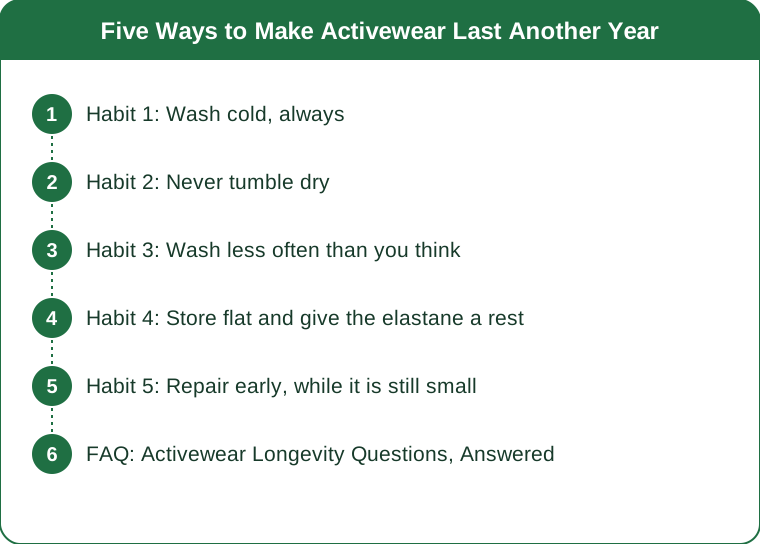
Habit 1: Wash cold, always
Heat is the primary enemy of elastane, and elastane is what makes activewear function.
Elastane fibres are a segmented polyurethane, and heat degrades the segments responsible for their elastic recovery. Every hot wash causes a small, permanent loss of recovery — the property that lets a legging return to shape rather than bagging at the knee and seat.
Wash at 30°C or below. Cold water is sufficient for activewear in almost every case, because the soils involved are sweat and body oils rather than the ground-in dirt that needs heat. Modern detergents are formulated to work at low temperatures.
Use less detergent, not more. Excess detergent does not rinse fully out of technical fabrics and builds up, which traps odour and reduces moisture-wicking performance. Roughly half the recommended amount is right for a load of activewear.
Skip the fabric softener entirely. Softener works by coating fibres with a lubricating film, which is precisely what destroys the wicking function of a technical fabric and traps odour in it. This is the most common single mistake in activewear care.
Wash inside out. The inside is the surface that contacts skin and carries the soil; the outside is the surface that shows abrasion. Washing inside out cleans the dirty side more effectively and protects the visible side.
Use a mesh bag. It reduces abrasion against other garments and against the drum, which is the main cause of pilling.
This one habit is worth more than the other four combined, and it costs nothing.
Habit 2: Never tumble dry
The second most damaging thing you can do, and the most avoidable.
A tumble dryer combines the two things elastane tolerates least: sustained heat and mechanical agitation. The heat degrades the fibre; the tumbling abrades the surface and accelerates pilling.
Air dry flat or on a rack. Not on a hanger for heavier pieces — a wet legging hung by the waistband stretches under its own weight and can permanently distort.
Do not dry in direct sunlight. UV degrades both elastane and dye. A shaded, ventilated spot dries almost as fast without the damage.
Do not dry on a radiator. Same problem as the tumble dryer, with the added issue of concentrated heat on one area.
Technical fabrics dry fast. This is the thing that makes air drying practical for activewear specifically — a polyester or nylon legging air dries in a few hours, compared with a day or more for a cotton item. The habit is far less inconvenient than it sounds.
If you must use a dryer, use the lowest heat setting or an air-only cycle, and remove the items while still slightly damp. This mitigates but does not eliminate the damage.
The visible evidence of dryer damage is worth knowing: waistbands that have lost their snap, knees that stay bagged, and a general loss of the “spring” a new legging has. All three are elastane degradation, and all three are largely preventable.
Habit 3: Wash less often than you think
Every wash cycle causes wear. Reducing the number of cycles directly extends life, and most activewear is washed more than it needs to be.
Sports bras and leggings worn for a light session — a walk, a gentle yoga class, wearing them around the house — often do not need a wash after a single wear. Air them fully and assess.
Anything genuinely sweated in should be washed, both for hygiene and because sweat residue degrades fabric over time if left. This is not an argument for wearing things indefinitely.
Air properly between wears. Hanging a damp garment in a ventilated space, spread out rather than bundled, is what makes a second wear viable. A garment left in a gym bag is not reusable and will develop persistent odour.
Spot clean rather than full washing where only one area needs attention.
Rotate more items. Having more pieces in rotation means each is washed less often and each lasts longer. This is a genuine argument for owning a reasonable number of pieces rather than two, and it sits slightly awkwardly with minimalism — but the total number of washes across the whole rotation is what determines wear.
On odour: persistent smell in synthetic activewear is usually bacteria in fabric that has accumulated detergent or softener residue. A single wash with a small amount of white vinegar in place of detergent, or a dedicated sports wash, usually resets it — and reducing detergent going forward prevents its return.
Habit 4: Store flat and give the elastane a rest
Less discussed than washing, and it matters more than people expect.
Elastane recovers with rest. A garment worn for a long day is under sustained tension throughout, and the fibres need time to return to their resting length. Wearing the same pair on consecutive days without a full day’s rest between accelerates the loss of recovery.
Rotate at least three pairs if you train most days. This is the practical implication of the point above.
Fold, do not hang, anything heavy. A hung legging is under constant gravitational load at the waistband, and over months that produces a stretched band. Folding removes the load entirely.
Do not store compressed under other items. Prolonged compression creates set creases in technical fabrics that do not fully release.
Store dry. Any residual dampness in a folded garment encourages bacterial growth and produces the persistent odour that people mistakenly attribute to the fabric being worn out.
Keep out of direct light. Storage in a sunlit spot fades dye and degrades elastane over a season, particularly for darker colours.
On seasonal storage: if you are putting summer pieces away for six months, wash them first — body oils left in fabric oxidise over time and produce stains and degradation that were not visible when you put them away.
Habit 5: Repair early, while it is still small
A repair at the first sign of failure takes ten minutes. The same repair after another month may not be possible.
The failure points are predictable:
- Seam splits at the crotch or inner thigh, the highest-stress area
- Elastic separating from the waistband at the stitch line
- A snag or small hole from a zip, velcro, or gym equipment
- Pilling between the thighs, which is abrasion rather than failure but leads to thinning
A small seam split is genuinely easy to fix. A stretch stitch or a zigzag on a sewing machine, or a backstitch by hand with stretchy thread, holds well. Doing it when the split is a centimetre is trivial; doing it when the split is ten centimetres and the fabric edges have frayed is not.
Pilling can be removed. A fabric shaver or a pumice-style pill remover, used gently, restores appearance considerably. It removes some fabric, so do it occasionally rather than habitually.
A snag should be pulled through, not cut. Cutting a pulled thread in a knit creates a hole that will run. Use a needle to draw the loop through to the inside instead.
Waistband elastic can be replaced on many garments, and it is a repair a local alterations shop will do inexpensively. A legging with perfect fabric and a dead waistband is worth saving.
Know when to stop. Fabric that has thinned to translucency between the thighs is at the end of its useful life as activewear. At that point the most useful thing is to keep it for lower-intensity use, or to find a genuine textile recycling route rather than a general clothing bin.
FAQ: Activewear Longevity Questions, Answered
How long should a good pair of leggings actually last?
With the habits above, two to four years of regular use is a reasonable expectation for a well-made pair worn a couple of times a week. Without them — hot washes and tumble drying — the same pair may show significant recovery loss within a year.
Does washing synthetics release microfibres, and can I do anything about it?
Yes, synthetic textiles shed microfibres in the wash. A dedicated filter bag or an in-machine filter captures a meaningful proportion, and washing less often, washing cold, and using shorter cycles all reduce shedding. Full-load washing sheds less per garment than small loads, because there is less agitation per item.
Is it better to buy recycled polyester activewear?
Recycled content reduces the impact of the material at production, which is a genuine benefit, but it does not change how the garment behaves in use or at end of life. The much larger variable is how many wears you get out of it — a well-made virgin-fibre piece worn for four years generally beats a recycled piece worn for one.
TL;DR:
- Wash cold, inside out, with half the detergent and no fabric softener — this single habit matters most
- Never tumble dry; heat plus tumbling is what kills elastane recovery
- Wash less often, air properly between light wears, and rotate more pieces
- Fold rather than hang, store dry and out of light, and give each pair a rest day
- Repair seam splits and snags immediately, while the fix is still ten minutes
None of this requires buying anything. The environmental argument and the money argument point the same direction here, which is unusual and worth taking advantage of.
See It in Motion
Seen here: High Waist 8” Yoga Shorts — shop similar styles on bubblelime.com
Keep Reading
This article is for general informational and styling purposes only. Fit, sizing, and product availability may vary.