Five Ways to Tell If an Activewear Brand's Recycling Claims Are Actually Real
Quick Answer: The five checks below — specific percentage disclosure, third-party certification, transparency about what happens after collection, whether the claim covers the whole garment or one component, and whether the brand publishes any data at all — separate a genuinely verifiable recycling claim from a vague, feel-good marketing statement.
Most shoppers can’t independently verify a supply chain, but these five checks use information brands are required or choose to disclose, and the gaps in that disclosure are usually the tell.

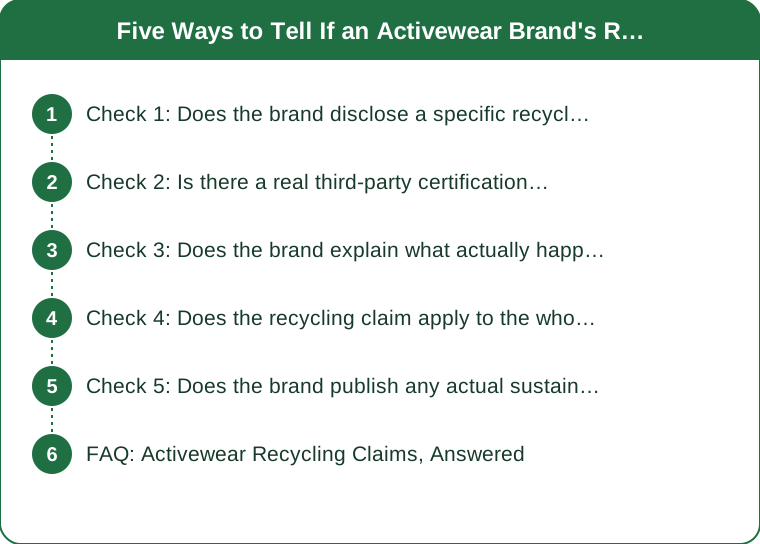
Check 1: Does the brand disclose a specific recycled content percentage?
A specific number (“78% recycled polyester”) is a far stronger signal than a vague phrase like “made with recycled materials,” which can legally apply to a garment that’s only a small single-digit percentage recycled content. Brands confident in their recycling claims generally disclose the actual percentage; vague language without a number is one of the most common greenwashing patterns.
Check 2: Is there a real third-party certification behind the claim?
Independent certifications (like the Global Recycled Standard) require documented chain-of-custody verification that a brand’s own unverified claim doesn’t — a certification logo with a checkable registration number is meaningfully more trustworthy than the same claim made without any third-party backing, since it means an outside body actually audited the supply chain claim.
Check 3: Does the brand explain what actually happens to garments after a take-back program collects them?
Many in-store take-back bins collect used clothing without a transparent, published explanation of where it actually goes — some genuinely go to textile recycling, but a meaningful portion of collected clothing in less transparent programs has been found to go to landfill, incineration, or low-value downcycling instead. A brand that publishes its actual downstream partner and process is showing real transparency; one that only says “we recycle it” without specifics is not.

Check 4: Does the recycling claim apply to the whole garment or just one component?
A shirt described as “made from recycled materials” might only have recycled content in the main body fabric, while the thread, elastic, zipper, and any trim are entirely virgin material — this is a common and technically-not-false way to make a claim sound more complete than it is, so checking whether the claim specifies “garment” versus a specific fabric component matters.
Check 5: Does the brand publish any actual sustainability data or report at all?
Brands with genuinely substantive recycling programs generally publish some form of annual sustainability report or impact data, even if imperfect — the complete absence of any published data, year after year, alongside prominent recycling marketing language, is one of the more reliable red flags for a claim that’s more marketing than substance.
FAQ: Activewear Recycling Claims, Answered
Is it possible for a brand to be genuinely sustainable in some ways but still greenwash in others?
Yes, this is actually common — a brand can have a legitimately certified recycled fabric program while still overstating an unrelated claim (like a take-back program), so evaluating each specific claim independently is more accurate than judging the brand as a single verdict.
Does a higher price for a “sustainable” activewear line guarantee it’s more legitimate?
No — price correlates only weakly with the legitimacy of a sustainability claim, since higher prices can reflect brand positioning and marketing spend as easily as genuine supply chain investment.
Are microplastic-shedding concerns relevant to recycled activewear fabric specifically?
Yes — recycled polyester still sheds microplastics during washing similarly to virgin polyester, so a fabric being recycled addresses a different environmental concern (waste diversion) than the shedding issue, and one claim doesn’t offset the other.
TL;DR:
- A specific recycled-content percentage is more trustworthy than vague “made with recycled materials” language
- Real third-party certification with a checkable registration number matters
- Transparent disclosure of what happens after a take-back program collects garments is a key differentiator
- Claims often apply to one fabric component, not the whole garment — check the specifics
- Published sustainability data (or its total absence) is one of the more reliable overall signals
See It in Motion
Seen here: Yoga Jogger Sweatpants with Pockets — shop it on bubblelime.com
Keep Reading
This article is for general informational and styling purposes only. Fit, sizing, and product availability may vary.