5 Second-Life Uses for Leggings That Are Genuinely Past Repair
Quick Answer: Blended synthetic activewear is difficult to recycle because separating elastane from polyester or nylon at scale is not commercially routine, so most worn-out leggings are not turned back into fabric no matter which bin they go in. Keeping them in use yourself is genuinely the higher-impact option. Five practical uses below, each of which replaces something you would otherwise buy new - and the last section covers what to do with the fragments when even these run out.
They are thin at the seat, pilled at the thigh, and the waistband has stopped gripping. Repair is not happening and the charity shop will not sell them.
Here are five things they are still genuinely good for.

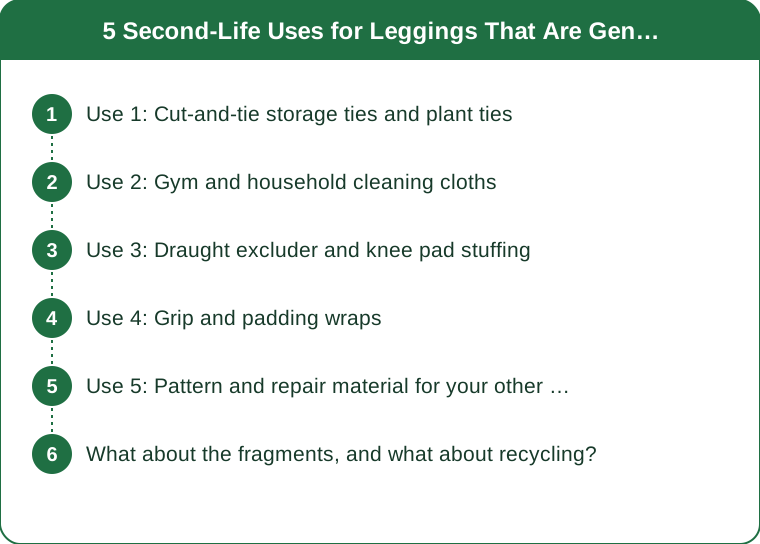
Use 1: Cut-and-tie storage ties and plant ties
What it is: the legs cut across into loops about 2cm wide, which stretch and self-grip when tied.
Why it works: activewear knit does not fray when cut across the grain, so a cut loop needs no hemming at all. The elastane that failed at garment scale is still perfectly functional at strip scale, and the soft edges make these gentler on plant stems than wire or plastic ties.
How to do it: cut straight across one leg to make a continuous loop, then cut that loop once to make a strip. Repeat up the leg. One pair of leggings produces roughly twenty to thirty usable ties in about five minutes.
Where they earn their place: staking tomatoes and climbers, bundling cables behind a desk, tying rolled camping mats, and holding a bike pump or a spare tube to a frame.
Watch out for: using dark strips in bright sun on plants - they absorb heat. Cut ties from the palest section of the garment for anything sitting in direct sunlight all summer.
Use 2: Gym and household cleaning cloths
What it is: flat panels cut from the leg and seat, used as reusable cloths for surfaces, equipment, and shoes.
Why it works: the same fine synthetic fibres that made the fabric wick sweat make it good at lifting dust and moisture from smooth surfaces. Polyester and nylon knits are effectively very close relatives of the microfibre cloths sold for exactly this job.
How to do it: cut the largest flat sections you can - usually the outer thigh and the seat - into roughly hand-sized squares. No hemming needed. Keep a stack under the sink and one in a gym bag.
Where they earn their place: wiping down home gym equipment, mirrors, screens, dashboards, and cleaning trainers. They replace disposable wipes, which is where the real impact sits.
Watch out for: washing them with other laundry. Cut synthetic cloths shed fibres, so wash them together in a filter bag and keep them separate from clothes you care about.
Use 3: Draught excluder and knee pad stuffing
What it is: the entire garment, cut roughly and used as filling material inside something else.
Why it works: compressed synthetic knit is a decent insulator and it does not absorb moisture or rot the way natural fibre stuffing does. A pair of leggings is a surprising volume of material once cut small.
How to do it: cut into pieces about 5cm square so it packs evenly rather than lumping. Stuff into a fabric tube for a door draught excluder, into a cushion cover, or into a simple sewn pouch for kneeling on while gardening.
Where they earn their place: the draught excluder in particular replaces something people buy new every autumn, and it uses up an entire garment in one project rather than producing more offcuts.
Watch out for: stuffing anything that will be washed frequently. Compressed synthetic filling takes a very long time to dry properly, so keep it to items that get surface-cleaned instead.

Use 4: Grip and padding wraps
What it is: long strips wrapped around handles, straps, and hard edges for padding and grip.
Why it works: the fabric is designed to be comfortable against skin under load for hours, which is exactly the requirement for a bag strap or a tool handle. It is also grippy when slightly damp, unlike most smooth materials.
How to do it: cut a continuous spiral strip from a leg to get a long length, then wrap tightly and tie or stitch the end. Two or three layers on a thin bag strap makes a substantial difference.
Where they earn their place: thin crossbody straps that cut into your shoulder, garden tool handles, hard chair edges, and the frame contact points on a bike where a lock rubs the paint.
Watch out for: anything with a safety function. Do not use these on load-bearing straps, climbing gear, or child equipment where the original design matters.
Use 5: Pattern and repair material for your other kit
What it is: keeping one pair specifically as a source of matching fabric, elastic, and hardware for repairing other activewear.
Why it works: the most useful repair material for stretch fabric is more stretch fabric with a similar weight and recovery, and it is difficult to buy in small quantities. A dead pair of leggings is a free supply of exactly the right thing.
How to do it: salvage the waistband intact - it is the single most reusable component - along with the drawcord, any elastic, and the largest undamaged panels. Store them flat in a labelled bag with your sewing kit.
Where they earn their place: patching a hole in the inner thigh of a newer pair, replacing a failed drawcord, and reinforcing a stressed seam from the inside. A patch in matching fabric is far more durable than any iron-on option.
Watch out for: keeping more than one or two donor garments. The point is a small salvage stock, not a bag of textiles that becomes its own clutter problem.
What about the fragments, and what about recycling?
Textile recycling for blends is genuinely limited. Separating elastane from polyester or nylon is chemically and commercially difficult, and while fibre-to-fibre recycling for blends is an active area of development, it is not the routine outcome for a pair of leggings in a collection bin today.
Check what your local scheme actually accepts. Some take worn textiles for downcycling into insulation and industrial wipers, which is a real outcome even though it is not new fabric. Others accept only wearable clothing, in which case worn-out kit in the bag is a problem rather than a contribution.
Some brands run genuine take-back programmes. A few operate their own collection with a specific stated end use. Worth checking the brand’s own page rather than assuming, and worth being sceptical of vague wording.
Keeping them in use beats every disposal route. The environmental cost is overwhelmingly in production, so five uses above extending the material’s life is a larger effect than any bin choice.
Wash offcuts in a filter bag. Cut synthetic pieces shed more fibres than intact garments, so if you are making cleaning cloths, a wash bag designed to capture microfibres is a sensible companion.
And buy fewer, better next time. The most effective thing in this whole article is the purchase you do not need to make because the previous pair lasted three years instead of one.
TL;DR:
- Blended activewear is hard to recycle into new fabric, so keeping it in use yourself is the higher-impact choice.
- Cut strips make self-gripping plant and cable ties; flat panels make excellent cleaning cloths that replace disposables.
- A whole pair stuffs a draught excluder or a kneeling pad, and spiral strips pad thin bag straps and tool handles.
- Keep one pair as donor material - the waistband, drawcord, and undamaged panels are the best repair stock for your other kit.
- Check what your local scheme actually accepts before bagging worn textiles, and wash synthetic offcuts in a filter bag.
Not everything can be mended. Almost everything can still be useful for another year or two before it becomes anyone else’s problem.
See It in Motion
Seen here: High Waist Embossed Yoga Leggings with Side Pockets — shop it on bubblelime.com
Keep Reading
This article is for general informational and styling purposes only. Fit, sizing, and product availability may vary.