Five Things That Actually Reduce the Impact of Your Activewear
Quick Answer: The highest-impact changes are the least glamorous: wear things longer before washing, wash cold and full, air dry instead of tumble drying, use a microfibre-capture bag or filter, and extend garment life through repair and careful storage. Buying a recycled-content legging matters far less than doubling how long you keep the one you own. Use is where most of the footprint sits.
The sustainability conversation about activewear is almost entirely about what to buy.
Most of the impact happens afterward, in a washing machine.

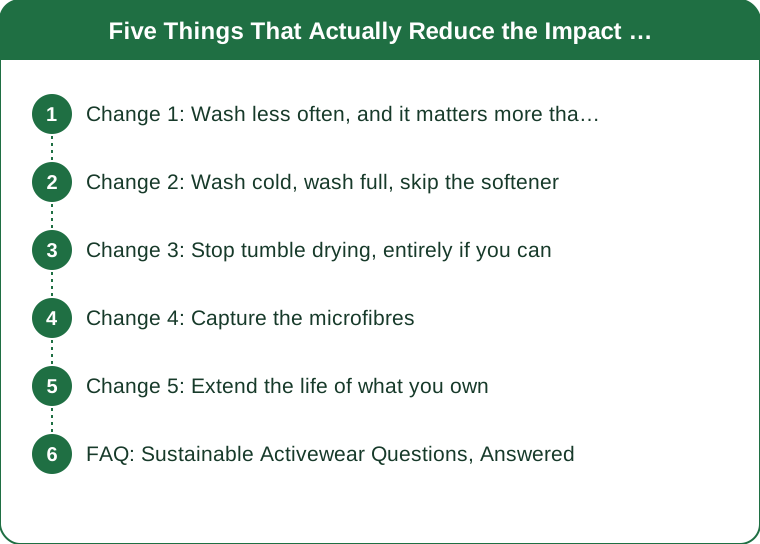
Change 1: Wash less often, and it matters more than it sounds
The change: wear activewear more than once before washing where it is reasonable, and spot-clean rather than full-washing when only part of it needs it.
Why it makes the most difference: each wash cycle uses water and energy, releases microfibres, and mechanically degrades the fabric. Washing is simultaneously an environmental cost and the main cause of your garment wearing out - the two problems have the same solution.
What is realistic: a heavily sweated legging or top needs washing. A garment worn for a walk, a yoga class, or a low-sweat session frequently does not. Airing it properly - hung, not folded in a bag - handles a great deal.
The practical rule: air it immediately after wearing rather than leaving it in a bag. Most of the odour problem comes from bacteria growing in a damp garment left balled up, which is a storage issue rather than a cleanliness one.
On odour specifically: synthetic fabrics hold odour more than natural fibres because bacteria bind to the fibre surface. Once odour is established in the fabric it becomes permanent, which is an argument for airing promptly rather than for washing more.
Merino is worth mentioning here: it resists odour considerably better than synthetics and can genuinely be worn many times between washes. For anyone interested in reducing wash frequency, it is the fibre that makes it easiest.
The saving compounds. Halving wash frequency halves the water, energy, microfibre release and mechanical wear at once - four benefits from one change.
Change 2: Wash cold, wash full, skip the softener
The change: 30°C or lower, full loads only, liquid detergent, no fabric softener.
Why temperature matters most: heating water accounts for a large share of a washing machine’s energy use. Washing at 30°C rather than 40°C cuts that substantially, and modern detergents are formulated to work at low temperatures.
Why cold is also better for the garment: heat degrades elastane. The waistband that has lost its snap has usually been through hot washes - so cold washing serves both purposes at once.
Why full loads: a machine uses similar energy regardless of load size. Two half loads use roughly twice the energy of one full one, and half-empty drums also allow more garment movement and abrasion.
Why no fabric softener - this one surprises people: fabric softener coats fibres with a hydrophobic layer. On performance fabric that destroys the moisture-wicking property, which is the specific thing you paid for. It also traps odour-causing bacteria and degrades elastane over time.
Fabric softener is the single most damaging thing most people do to activewear, and it is done with good intentions.
Two more small adjustments:
- Turn garments inside out. The inside faces your skin and takes the sweat; the outside takes the visible abrasion. Washing inside out protects the visible surface
- Use liquid rather than powder. Powder can leave residue in technical fabrics that reduces breathability
On detergent quantity: more is not better. Excess detergent leaves residue that holds odour, which produces the exact problem people add more detergent to solve.
Change 3: Stop tumble drying, entirely if you can
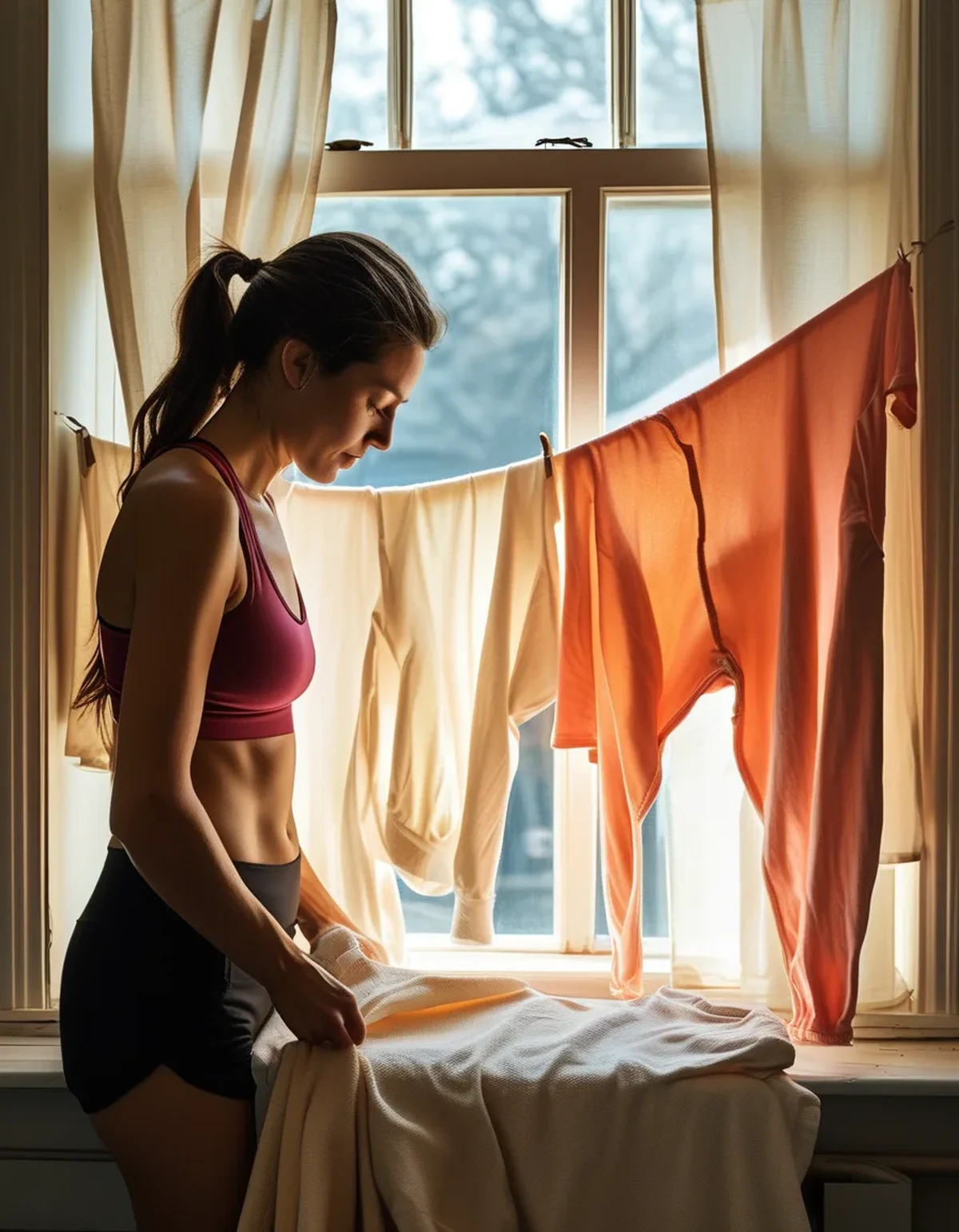
The change: air dry activewear rather than tumble drying it.
Why it matters environmentally: tumble dryers are among the most energy-intensive household appliances. Removing that step from your activewear laundry is one of the larger energy reductions available in the whole category.
Why it matters for the garment: heat is the primary enemy of elastane. Tumble drying is the fastest way to destroy the recovery in a legging waistband and to cause pilling through mechanical abrasion.
Activewear air dries very quickly, which is the useful part. Performance fabrics are engineered to move moisture and dry fast - most items are dry in a few hours indoors, considerably faster than cotton.
How to do it well:
- Hang rather than lay flat, so air circulates on both sides
- Do not hang in direct sunlight - UV degrades elastane and fades colour
- Do not hang leggings by the waistband on a narrow hanger - it stretches; fold over a rail instead
- Indoors near a window with airflow works fine and is faster than most people assume
On sports bras specifically: never tumble dry them. The elastic in the band is what provides support, and heat destroys it faster than anything else. A tumble-dried sports bra loses support long before it looks worn.
The combined effect of cold washing and air drying: it substantially extends the usable life of stretch garments. Given that manufacturing dominates a garment’s total footprint, keeping a garment twice as long roughly halves its per-wear impact - which makes care the highest-leverage sustainability action available to an owner.
Change 4: Capture the microfibres
The change: use a microfibre-capturing wash bag, an in-drum capture ball, or an external machine filter.
What the problem is: synthetic textiles shed microscopic plastic fibres during washing. These pass through wastewater treatment and enter waterways, and textiles are recognised as a significant contributor to microplastic pollution.
Since most activewear is synthetic by necessity - polyester, nylon and elastane provide the stretch and moisture management that make it work - this is the category’s most specific environmental issue.
What actually helps:
- A microfibre wash bag. You put garments inside and the bag retains a substantial share of released fibres, which you then remove and bin
- In-drum capture devices, which collect fibres from the whole load
- External filters fitted to the machine outlet, which are the most thorough option and require installation. Some jurisdictions have moved toward requiring them on new machines
What also reduces shedding:
- Washing less often - the first change on this list does double duty
- Cold water and shorter cycles, both of which reduce mechanical agitation
- Full loads, which reduce garment-to-drum abrasion
- Not tumble drying, which also releases fibres
An honest note: shedding is highest when garments are new and decreases over the garment’s life. Which is another argument for keeping things longer - the high-shedding phase is front-loaded, so a garment kept for five years sheds far less per year of use than one replaced annually.
Change 5: Extend the life of what you own
The change: repair, store properly, and buy for longevity rather than for replacement.
Why this dominates everything else: manufacturing accounts for the majority of a garment’s total footprint. The single most effective thing an owner can do is keep a garment in use longer - it spreads that fixed cost across more wears.
Repairs that are genuinely worth doing:
- A split seam is straightforward to restitch, by hand or by a repair service
- A small hole can be patched from the inside
- A broken drawcord is a two-minute replacement
- Pilling can be removed with a fabric shaver, which restores appearance considerably
What is not repairable: thinned, sheer fabric and dead elastane. Both are the accumulated result of heat and abrasion, which is why care matters more than repair.
Storage matters more than people think:
- Fold rather than hang leggings, since hanging stretches them over time
- Store sports bras with the cups unfolded - folding one cup into the other permanently deforms the shape
- Keep out of direct sunlight, which degrades elastane even in storage
At end of life: many activewear brands and larger retailers run take-back schemes. Worn-out synthetics should not go to a charity shop - they cannot be sold and become a disposal cost for the charity. Textile recycling is the correct destination.
On buying: the most sustainable purchase is the one that lasts and gets worn. Recycled content is a genuine positive and matters less than durability and whether you actually wear it. A recycled-polyester legging worn twice is worse than a conventional one worn three hundred times.
FAQ: Sustainable Activewear Questions, Answered
Is recycled polyester actually better?
It reduces virgin plastic demand and typically has a lower manufacturing footprint. It sheds microfibres the same as conventional polyester, and it does not change the end-of-life problem. It is a genuine improvement rather than a solution.
How often should I really wash leggings?
After any session with significant sweat. After a low-sweat activity, airing them properly and wearing again is reasonable. The important part is hanging them to air immediately rather than leaving them balled up in a bag.
Do microfibre wash bags actually work?
Testing has found they capture a meaningful share of released fibres. They are not complete, and combined with washing less, cold water and full loads they make a real difference. External machine filters capture more.
Is natural fibre activewear a better choice?
Merino is excellent for odour resistance and does not shed plastic microfibres, and it is less durable for high-abrasion use and more expensive. Cotton holds moisture, which makes it poor for sweaty training. Most performance applications genuinely need synthetics, which is why the focus is on care rather than on avoiding them.
What should I do with worn-out activewear?
Textile recycling, or a brand take-back scheme if one exists. Do not donate items that are sheer, stretched out or that hold odour - charity shops cannot sell them and disposal becomes their cost.
Does buying fewer, better pieces actually help?
Yes, provided you wear them. Manufacturing dominates the footprint, so wears-per-garment is the number that matters. A cheap piece worn constantly beats an expensive one worn rarely.
TL;DR:
- Most of a garment’s footprint is manufacturing, so keeping things longer is the highest-leverage change available
- Wash less often, and air garments immediately rather than leaving them balled up in a bag
- Cold, full loads, liquid detergent, inside out, and never fabric softener - it coats fibres and destroys wicking
- Never tumble dry stretch fabric; heat is what kills elastane and support
- Use a microfibre wash bag or filter, and note that shedding is highest when garments are new
- Fold leggings rather than hanging, store bras with cups unfolded, and recycle rather than donate worn-out synthetics
The washing machine matters more than the label.
See It in Motion
Seen here: Crewneck Short Sleeve Workout T-Shirt — shop it on bubblelime.com
Keep Reading
This article is for general informational and styling purposes only. Fit, sizing, and product availability may vary.