Five Signs Your Activewear Is Nearing the End and What to Do With Each
Quick Answer: Activewear rarely fails all at once - it fails in five distinct ways, and each has a different correct destination. Lost elastic recovery and structural seam failure mean the garment’s performance life is over; pilling and fading are cosmetic and often mean demotion rather than disposal; persistent odor is usually fixable. Knowing which one you have prevents both throwing away working clothes and keeping items that stopped doing their job months ago.
The honest question is not whether they look new. It is whether they are still doing the thing you bought them to do.

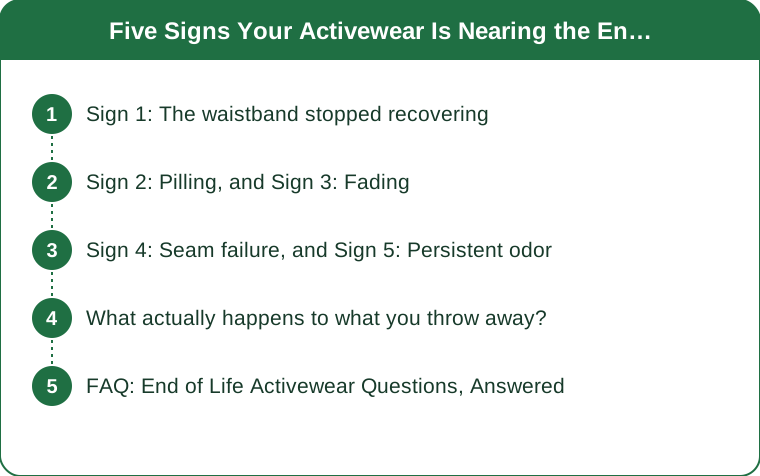
Sign 1: The waistband stopped recovering
This is the real end of a garment’s performance life, and it is the one people most often ignore.
What it looks like: the waistband no longer snaps back after being stretched. It sits slightly wide, rolls down during a workout, or needs adjusting repeatedly. The garment still looks fine on a hanger.
What is happening: elastane fibers degrade with heat, chlorine, body oils, and repeated cycling. This is irreversible - there is no wash, product, or technique that restores lost recovery, despite what a lot of internet advice claims.
How to test it: stretch a section of the waistband, hold for 30 seconds, and release. Good elastic returns immediately and fully. Degraded elastic returns slowly or incompletely.
What to do with it: performance use is over, but the fabric is intact. Demote to gentle use - lounging, walking, sleeping - where recovery does not matter. When even that stops working, it goes to textile recycling rather than donation, since worn-out elastic is exactly what makes donated activewear unusable to the next person.
How to slow it next time: avoid the dryer entirely, wash cold, skip fabric softener, and rotate between pairs. Heat is the primary killer of elastane by a wide margin.
Sign 2: Pilling, and Sign 3: Fading
Two cosmetic failures that people treat as terminal and usually should not.
Sign 2: Pilling. Small fiber balls at the inner thigh, seat, or under strap lines. It happens when short fibers work loose under friction and tangle.
What it means: the fabric surface is wearing, but the structure and elastic are usually still fine. Pilling is not a sign the garment is finished - it is a sign it has been used.
What to do: a fabric shaver or sweater comb removes pills in a few minutes and genuinely restores appearance. Do it dry, on a flat surface, with light pressure. This works repeatedly, though each pass removes a small amount of fabric, so heavily pilled areas will eventually thin.
Sign 3: Fading. Color loss, especially at the knee, seat, and anywhere sunscreen contacts fabric.
What it means: almost always cosmetic. Fading from sunscreen, chlorine, and UV affects the dye, not the fiber strength.
What to do: demote to outdoor and dirty-work use where appearance matters least - gardening, painting, dog walking in mud. A faded but structurally sound legging has years of use left in the right role. Wash inside out and skip the dryer to slow further fading on the pieces you still care about.
Sign 4: Seam failure, and Sign 5: Persistent odor
One genuinely terminal and one almost always fixable, and people regularly get them the wrong way round.
Sign 4: Seam separation. Visible gaps in stitching, a seam that has split, or fabric pulling away at a stress point - usually the crotch gusset or inner thigh.
What it means: structural failure. Once a seam goes in a high-stress area, the surrounding stitching is usually under strain too.
What to do: a single small split on a low-stress seam is genuinely repairable - a stretch stitch or a zigzag on a home machine holds well, and a five-minute repair can add a year. A split at the gusset or a seam that has failed in more than one place is the end; that garment goes to textile recycling.
Sign 5: Odor that survives washing. The smell returns within minutes of putting the garment on, even after a normal wash.
What it means: bacteria and body oils have built up in the fibers, and synthetic fabrics hold oils that ordinary detergent does not fully remove. This is not the garment wearing out - it is a buildup problem with a specific fix.
What to do: soak in a solution of one part white vinegar to four parts cold water for 30 minutes, then wash cold with a sports detergent designed for synthetics, and air dry completely. Two or three cycles resolve most cases. If it genuinely does not resolve, then the garment is finished - but try the soak first, because most people discard perfectly good clothing over this.
What actually happens to what you throw away?
Worth knowing, because it changes which of the destinations above is worth the effort.
Donation bins are not a solution for worn activewear. Charity shops resell a fraction of what they receive, and stretched, pilled leggings are close to unsellable. Donating worn-out activewear mostly moves the disposal problem to an organization with less capacity to handle it than you have.
Textile recycling is real but limited. Blended synthetics - the standard nylon-elastane or polyester-elastane construction - are difficult to separate into recoverable materials, so most goes to downcycling: insulation, industrial rags, carpet padding. That is genuinely better than landfill and it is not closed-loop recycling.
Brand takeback programs vary widely. Some genuinely process garments; others primarily provide store credit. Worth using, worth not assuming too much about.
The largest lever is upstream. Extending a garment’s life by nine months reduces its overall footprint substantially, which means the demotion steps in this article do more good than any disposal decision. Washing cold, skipping the dryer, and rotating between pieces are the highest-impact habits available.
And rags are legitimate. Cotton-blend tops make excellent cleaning cloths. It is not glamorous and it directly displaces buying paper towels.
FAQ: End of Life Activewear Questions, Answered
How long should activewear actually last?
With regular use - say twice a week - and good care, two to four years for a mid-range legging is reasonable, and heavily used pieces reach end of performance life in about a year. Care matters more than price within a wide band.
Can I recycle activewear in curbside bins?
No. Curbside recycling does not accept textiles anywhere in most regions, and putting them in contaminates the stream. Textiles need a dedicated collection point - many municipalities and some retailers have them.
Is it worth repairing a legging?
For a small seam split, yes - it takes minutes and works. For failed elastic or a gusset blowout, no; there is nothing to restore. Repair the structure, do not try to repair the stretch.
What is the single best habit for making them last?
Skipping the dryer. Heat degrades elastane faster than anything else in a normal laundry routine, and air drying is the closest thing to a free lifespan extension available.
Does washing less actually help?
Yes, within reason. Washing after every heavy workout is necessary; washing after a light wear is not. Fewer cycles means less mechanical and chemical stress, and less microfiber shedding as well.
TL;DR:
- Five distinct failures, five different answers: lost recovery and seam failure are terminal; pilling, fading, and odor usually are not.
- Lost elastic recovery cannot be restored by anything - demote the garment to gentle use, then textile recycling.
- Pills come off with a fabric shaver, fading means demotion to dirty-work duty, and odor responds to a 1:4 vinegar soak plus sports detergent.
- Do not donate worn-out activewear; it is unsellable and shifts the problem. Textile recycling is the honest destination.
The most useful shift is separating cosmetic wear from functional wear. A faded, pilled legging that still recovers is a working garment with a new job. A pristine-looking pair with a dead waistband stopped working months ago and nobody noticed, because it still looked fine folded in a drawer.
See It in Motion
Seen here: High Waist Yoga Leggings with Inner Pocket — shop it on bubblelime.com
Keep Reading
This article is for general informational and styling purposes only. Fit, sizing, and product availability may vary.