5 Signs Your Old Leggings Are Worth Repairing Instead of Replacing
Quick Answer: Small seam separations, minor waistband elastic loosening, tiny snags, and a single small hole are all genuinely repairable in under 15 minutes with basic supplies — the pieces actually worth replacing are ones with widespread fabric thinning, lost compression across the whole garment, or fabric that’s gone see-through from wear.
A quick five-point check before tossing a worn piece saves both money and unnecessary waste.

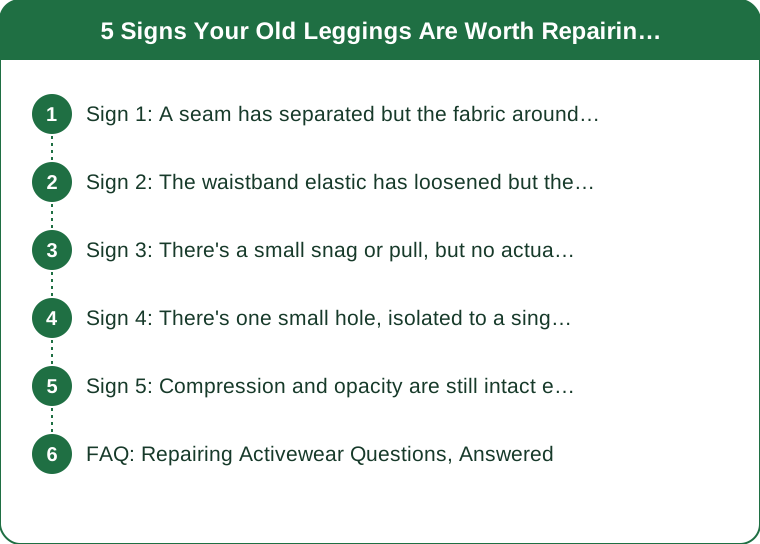
Sign 1: A seam has separated but the fabric around it is still solid
Seam separation is one of the most common and easiest activewear repairs — it’s a stitching failure, not a fabric failure, meaning the material itself is still fully functional. A basic sewing machine zigzag stitch or even a careful hand stitch with stretch-friendly thread fixes this in a few minutes and holds up well afterward.
Sign 2: The waistband elastic has loosened but the leg fabric is still opaque and stretchy
Loose waistband elastic is a localized, replaceable component, not a sign the whole garment is done. A short section of replacement elastic sewn into the existing waistband channel restores fit without needing to replace the entire piece — a common and low-cost repair.
Sign 3: There’s a small snag or pull, but no actual hole yet
A snag that hasn’t progressed to a full hole can usually be pulled through to the inside of the fabric with a needle or snag tool, smoothing the outside surface back to nearly its original look. Left unaddressed, snags do tend to worsen with wear, so catching this stage early is what makes the repair this easy.

Sign 4: There’s one small hole, isolated to a single spot
A single small hole, especially in a low-visibility area (inner thigh seam, underarm), can be patched with a fusible fabric patch or a few stretch stitches from the inside, which is far less noticeable than most people expect. This is different from fabric that’s thinning broadly across the garment — an isolated hole in otherwise solid fabric is a genuinely easy fix.
Sign 5: Compression and opacity are still intact everywhere except the damaged spot
If the rest of the garment still holds its shape and isn’t see-through under stretch, the piece has real remaining life left and is worth the small repair effort. This is the actual dividing line between “worth repairing” and “time to replace” — localized damage on otherwise sound fabric versus fabric that’s uniformly broken down.
FAQ: Repairing Activewear Questions, Answered
What supplies do you actually need to do these repairs at home?
A spool of stretch or elastic thread, a hand-sewing needle (or a machine with a zigzag stitch setting), and a small fusible patch kit cover the vast majority of common activewear repairs.
Is it worth paying a tailor for activewear repairs instead of doing it yourself?
For waistband elastic replacement specifically, a tailor is often worth it since it requires removing and resewing the waistband channel cleanly — simpler repairs like snags and small holes are very doable at home.
How do you know when fabric thinning has gone too far to repair?
If the fabric feels noticeably thinner to the touch across a large area, or shows any see-through under normal stretch, that’s uniform fabric breakdown rather than a fixable spot issue, and replacement is the more realistic option.
TL;DR:
- Seam separation, loose elastic, snags, and isolated small holes are all genuinely repairable
- The real replace-vs-repair line is localized damage versus widespread fabric thinning
- Basic stretch thread, a needle, and a fusible patch kit cover most home repairs
- Catching snags and small holes early makes the repair meaningfully easier
A five-minute check before discarding a worn piece often reveals it has real life left in it.
See It in Motion
Seen here: Super High Waist Embossed Yoga Leggings with Inner Pocket — shop it on bubblelime.com
Keep Reading
This article is for general informational and styling purposes only. Fit, sizing, and product availability may vary.