The Five-Pile End of Summer Activewear Audit
Quick Answer: Sort every piece into five piles, not two. Keep-as-is, repair, demote, rehome, and retire. The mistake almost everyone makes is running a keep-or-toss binary, which sends repairable and still-useful pieces straight to a bin. A proper audit takes about 40 minutes for a drawer of 30 pieces, and the average outcome is that only 2-3 items are genuinely finished.
Right now your activewear has just been through the hardest twelve weeks of its year. Heat, sweat, sunscreen, chlorine, and probably a few too many hot-car afternoons. That makes late August the single most honest moment to look at all of it at once, because nothing is hiding behind a winter of gentle indoor use.

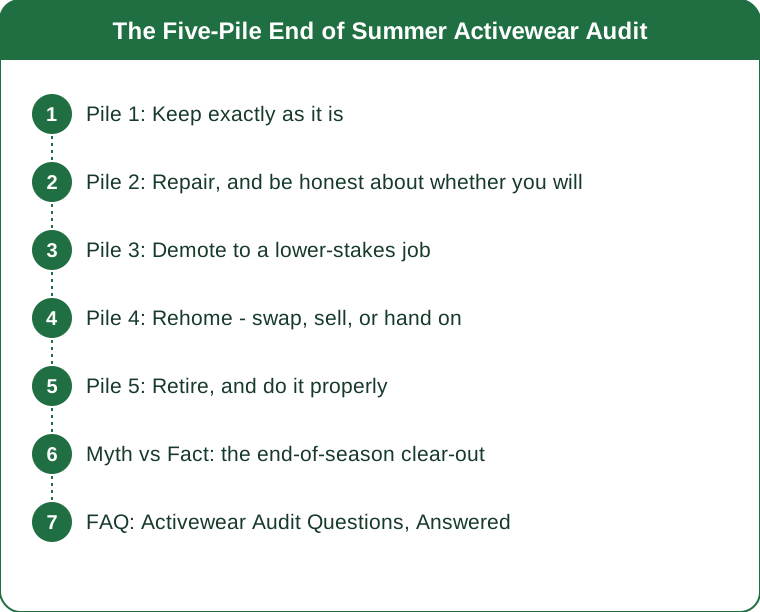
Pile 1: Keep exactly as it is
This is the pile you want to be biggest, and for most people it is - roughly 60-70% of a drawer lands here.
A piece qualifies if it still passes three checks. Recovery: stretch the waistband and let go; it should snap back with no lag and no wave in the fabric. Opacity: bend forward in front of a mirror in daylight, not lamplight. Seam integrity: run a thumb along the inseam and the gusset looking for skipped stitches or thread ends working loose.
If all three pass, fold it and put it back. Do not get talked out of a good legging by a single faded patch - colour loss is cosmetic and does not predict structural failure. The pieces that fail this year are almost always the ones you bought the cheapest, wore the most, or washed hot.
Pile 2: Repair, and be honest about whether you will
This pile is where good intentions go to die, so give it a deadline.
Genuinely worth repairing: a popped seam under 3 inches, a drawstring that has pulled out, a snagged thread on an otherwise sound panel, a sports bra with a stretched-out band but intact cups, and any zip pull that has come off a pocket. Most of these are 10-minute fixes with a needle and a stretch stitch, and a stretched bra band is a $8 job at a tailor.
Not worth repairing: anything with thinning at the fabric itself rather than at a seam. Once the knit has gone translucent at the seat or the inner thigh, a stitch just moves the stress an inch over and it fails again in a fortnight.
Set the deadline at two weeks. Write it on a sticky note on the pile. Anything unrepaired by then drops one pile down - that rule is what keeps this from becoming a permanent bag on a chair.
Pile 3: Demote to a lower-stakes job
This is the pile that most people never build, and it is the one that saves the most money.
A legging that has lost its compression is still a completely functional dog-walking legging, a gardening legging, a house-in-the-evening legging, or a layer under a ski trouser. A sports bra that no longer supports a run is a fine yoga bra. A tee that has gone slightly transparent at the shoulders is a perfect painting shirt.
The reason this matters: every demoted piece is one you do not buy new. The average woman replaces house-and-errand clothes with brand-new items far more often than she realises, and demoted activewear covers that entire category for years.
Keep the demoted pile in a different drawer or a labelled bin, not mixed in with the good stuff. If it lives next to your training kit you will grab it by accident on a day you needed real support, decide the whole drawer is tired, and go shopping.

Pile 4: Rehome - swap, sell, or hand on
This is for pieces that are objectively in good condition but wrong for you. Wrong rise, wrong length, a colour you never reach for, a size you have moved past.
These have real value and should not be demoted. Resale on secondhand platforms works best for recognisable, technical, under-two-years-old pieces - list them with the actual measurements rather than just the size label and they move faster. Local activewear swaps have picked up sharply and are the fastest route for basics.
For anything unsold after a month, hand it to a person rather than a bin. Shelters, community sports programmes, and school PE departments take clean, functional leggings and sports bras and use them immediately. A bin is a lottery; a person is a guarantee.
Wash everything before it leaves the house. It sounds obvious and it is the single most common reason donated activewear gets pulled at sorting.
Pile 5: Retire, and do it properly
This should be the smallest pile - usually 2-3 pieces out of thirty.
A piece is genuinely finished when the knit itself has failed: see-through at stress points, elastic that has gone crunchy or crumbly, or a smell that has survived a proper vinegar soak and a full wash. That last one is bacteria embedded in the fibre, and no amount of washing brings it back.
Before it goes anywhere, harvest it. Cut off the elastic waistband for use as a resistance loop or a bag tie, and cut the good panels into rags - technical knit makes an excellent lint-free cloth for screens and glasses.
What is left is genuinely hard to recycle honestly, because blended synthetics have no clean fibre-to-fibre route at scale. Take-back programmes run by brands are the most traceable option available, and a few municipal textile streams accept blends for downcycling into insulation and industrial wipes. Neither is perfect. The honest conclusion is that the environmental work happened in piles 1 through 4 - this pile is just the tidy ending.
Myth vs Fact: the end-of-season clear-out
Myth: A big clear-out is the sustainable move. Fact: A big clear-out is usually the prelude to a big restock. The sustainable move is a small, accurate clear-out that keeps things in circulation longer.
Myth: Faded means finished. Fact: Fade is dye loss at the surface. Structural failure is elastane breakdown. They are unrelated, and fade often shows up first on the pieces you wore most - which are frequently your best-made ones.
Myth: Recycling bins handle activewear fine. Fact: Most blended activewear is not fibre-to-fibre recyclable today. Take-back schemes are more traceable, but the honest answer is that keeping it in use is doing far more than the bin ever will.
FAQ: Activewear Audit Questions, Answered
How often should I actually do this?
Twice a year is plenty - late August and late February, at the two points where the season flips. Doing it more often just moves things between piles without changing anything.
What if almost everything lands in the repair pile?
That usually means one washing habit is aging the whole drawer at once. Check your water temperature and whether you are using fabric softener - softener coats elastane and is the most common cause of drawer-wide early failure.
Should I buy replacements the same day?
No. Wait a week and see what you actually miss. Most people find the demoted pile covers two or three of the gaps they were about to shop for.
TL;DR:
- Sort into five piles, not two - keep-or-toss thinking is what sends repairable pieces to the bin.
- The demote pile is the one that saves the most money, because it replaces things you would otherwise buy new.
- Give the repair pile a two-week deadline, then let it drop a pile automatically.
- Only 2-3 pieces out of thirty are usually genuinely finished - and even those give you rags and a resistance loop.
Do this once at the end of August and the drawer stays honest for the rest of the year. The best part is that it usually ends with you owning less and needing to buy nothing.
See It in Motion
Seen here: Round Neck Long Sleeve Athletic T-Shirt — shop it on bubblelime.com
Keep Reading
This article is for general informational and styling purposes only. Fit, sizing, and product availability may vary.