5 End-of-Summer Care Steps That Add a Year to Your Activewear
Quick Answer: Summer does specific, identifiable damage to activewear — salt crystals abrade elastane, chlorine breaks it down chemically, sunscreen leaves oils that block wicking, and UV degrades fibers directly. Five end-of-season steps reverse most of it: a deep salt soak, a sunscreen-focused degrease, a pilling pass, a repair triage, and correct storage.
The leggings that started June feeling great now feel loose, look dull, and smell faintly of something no wash has removed.
That is four distinct kinds of damage, and each one has a specific fix.

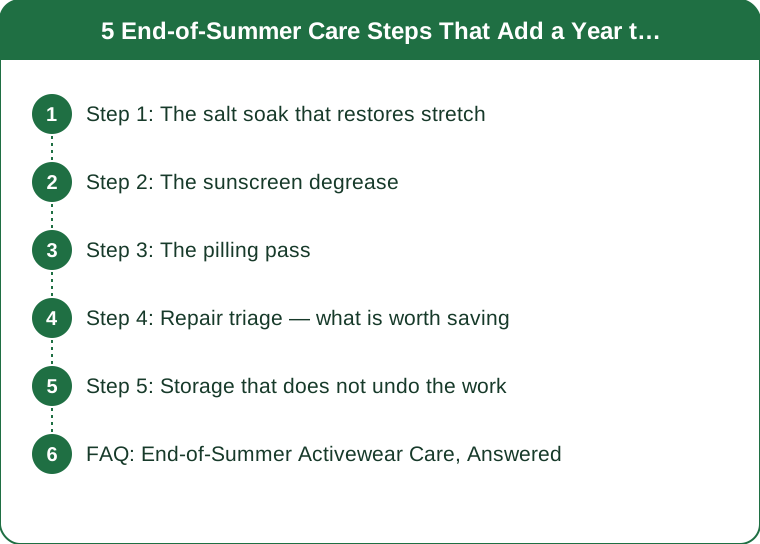
Step 1: The salt soak that restores stretch
What it fixes: waistbands that have stopped holding and fabric that has lost its snap.
Salt from sweat crystallizes inside the fabric as it dries, and those crystals are physically abrasive — every subsequent movement grinds them against the elastane fibers. This is the single biggest cause of elastane failure in activewear, and it accumulates invisibly over a summer of sweaty sessions and rushed washes.
The soak: fill a basin with cool water and add half a cup of white vinegar per gallon. Submerge the garments, squeeze water through them repeatedly for a minute, then leave them for 30 minutes. Rinse thoroughly in clean cool water until no vinegar smell remains.
Vinegar dissolves the mineral and salt deposits that plain washing leaves behind, and it also neutralizes the odor compounds that survive detergent. Do this on every piece you wore for sweaty summer training, one basin at a time.
What you will notice afterward is a fabric that feels less stiff and a waistband with more snap. Recovery that has been physically damaged does not come back — but the portion that was simply clogged with salt does, and on most garments that is a meaningful share.
Step 2: The sunscreen degrease
What it fixes: fabric that no longer wicks, feels waxy, or holds odor no matter how often you wash it.
Sunscreen is unavoidable and it is the second-biggest villain of the season. The oils and film-forming ingredients coat fibers and fill the tiny capillary spaces that moisture-wicking depends on. A garment with sunscreen buildup has effectively stopped being performance fabric, and normal cold washes do not remove it — cold water is specifically bad at dissolving oils.
The degrease: soak in warm water — not hot, around 100°F — with a small amount of plain dish soap, a teaspoon per gallon. Dish soap is formulated to cut oils, which is exactly the job. Twenty minutes, agitate a few times, then rinse extremely thoroughly. Residual soap clogs fabric as effectively as the sunscreen did, so rinse more than feels necessary.
Where to concentrate: shoulders, upper back, neckline, and the inside of sports bra bands, which get the most sunscreen contact.
One warning worth knowing: sunscreens containing avobenzone can react with iron in hard water and leave permanent orange or rust-colored stains, particularly on light fabrics. Those stains are chemical rather than dirt, and they generally do not come out. If it has happened, it is not something you did wrong in the wash.
Step 3: The pilling pass
What it fixes: the fuzzy, worn appearance that makes a functional garment look finished.
Pilling happens where fabric rubs — inner thighs, under bag straps, the back of leggings against a car seat or gym bench. Short fibers work loose, tangle, and ball up. It is a surface issue, not a structural one, which means a garment that pills is usually still perfectly good.
The fix: a fabric shaver or a fine-tooth pill comb, used on dry fabric laid flat. Work in one direction with light pressure. Do not use a razor blade freehand — it is the classic shortcut and it cuts the fabric itself with alarming frequency.
A dedicated fabric shaver costs very little and does the whole wardrobe in twenty minutes. The visual improvement is disproportionate to the effort, and it is the step that determines whether you keep wearing something or quietly stop.
To reduce it next season: turn garments inside out before washing, use a mesh laundry bag, wash with similar fabrics rather than with towels or denim, and never use a dryer. Friction is the cause, and every one of those reduces it.

Step 4: Repair triage — what is worth saving
What it fixes: the pile of “I should do something about that” garments that quietly become landfill.
Go through everything and sort into three piles honestly.
Worth repairing: a popped seam, a broken drawcord, a small hole away from a stress point, a detached elastic at a hem, a broken zipper pull. Seam repairs are the highest-value fix by a wide margin — a blown crotch seam on otherwise good leggings takes a tailor minutes and costs a fraction of replacement.
Worth demoting: garments that are sheer when stretched, permanently stained, or have lost recovery. These are no longer good for the gym and are entirely fine for gardening, house cleaning, dog walking, or sleeping in. Demotion is not failure — it is the longest-lasting form of use.
Genuinely done: fabric that has thinned to transparency, elastic that has gone brittle and cracked, or multiple seam failures. At this point repair costs more than the remaining life is worth.
For the genuinely done pile: textile recycling programs exist but are limited, since blended synthetic fabrics are difficult to process. Check whether your municipality or a local retailer runs a takeback scheme before assuming the bin is the only option — and be realistic that donation bins are not a recycling route for worn-out synthetic activewear.
Step 5: Storage that does not undo the work
What it fixes: the elastic degradation that happens over months of doing nothing at all.
Elastane degrades with heat, UV light, and prolonged compression — all three of which happen in ordinary storage without anyone noticing.
Fold, do not hang. Hanging stretchy garments over months lets gravity pull the fabric permanently out of shape, particularly at the shoulders on tops and at the waistband on bottoms. Fold flat, stack loosely.
Store away from light. UV degrades synthetic fibers directly, and a shelf near a sunny window does measurable damage over a season. A closed drawer or closet is the right place.
Store cool and dry. An attic or an uninsulated garage subjects fabric to heat cycling that ages elastic faster than wearing it would. Interior closets are far better.
Store completely dry. Any residual dampness in a folded stack invites mildew, and mildew smell in synthetic activewear is extremely difficult to remove once established.
Do not compress hard. Vacuum bags and tightly stuffed bins hold elastic under sustained tension for months. Loose folding in an open bin is better.
The pieces you will not wear again until spring are exactly the ones this matters for — they are about to spend seven months in whatever conditions you leave them in.
FAQ: End-of-Summer Activewear Care, Answered
Can I do the vinegar soak and the dish soap soak at the same time?
No — do them separately, salt soak first, then degrease. They target different residues and combining them dilutes both. Rinse fully between the two.
Will any of this restore lost stretch?
Partly. Stretch lost to salt clogging comes back; elastane fibers that have physically broken do not. If a waistband improves noticeably after the vinegar soak, it was clogged. If it does not, it is worn.
How often should I do this during the season, not just at the end?
A vinegar soak monthly through heavy summer use is worth it, and a degrease whenever fabric starts feeling waxy. The end-of-season pass is a catch-up, not a substitute.
Is fabric softener ever okay on activewear?
No. It works by coating fibers with a lubricating film, which is exactly what destroys wicking and traps odor. It is the single worst thing you can put on performance fabric.
TL;DR: Summer does four distinct kinds of damage, and five steps reverse most of it.
- Salt soak: half a cup of white vinegar per gallon, 30 minutes. Dissolves the abrasive crystals grinding away your elastane.
- Sunscreen degrease: warm water and a teaspoon of dish soap, 20 minutes, rinsed very thoroughly. Cold washes do not remove oils.
- Pilling pass: a fabric shaver on dry fabric, never a freehand razor.
- Repair triage: seam repairs are the highest-value fix; demote the rest rather than discarding it.
- Storage: fold flat, away from light, cool, dry, and not compressed. Seven months of bad storage undoes everything else.
Start with the vinegar soak this weekend. It is the one that makes the biggest difference to how things feel.
See It in Motion
Seen here: High Waist Yoga Leggings with Side Pockets — shop it on bubblelime.com
Keep Reading
This article is for general informational and styling purposes only. Fit, sizing, and product availability may vary.