5 At-Home Activewear Repairs That Actually Hold
Quick Answer: Five repairs cover almost everything that sends activewear to the bin: a split seam, a stretched waistband drawcord channel, a small hole in the thigh, a delaminating logo or waistband tape, and a dead elastic edge. All five need stretch-capable stitching - a zigzag stretch stitch or a hand backstitch worked loosely - because a rigid straight stitch will pop the first time you squat in it.
The reason home repairs on stretch fabric fail is almost never the sewing. It is using a stitch that does not stretch, on fabric that does.

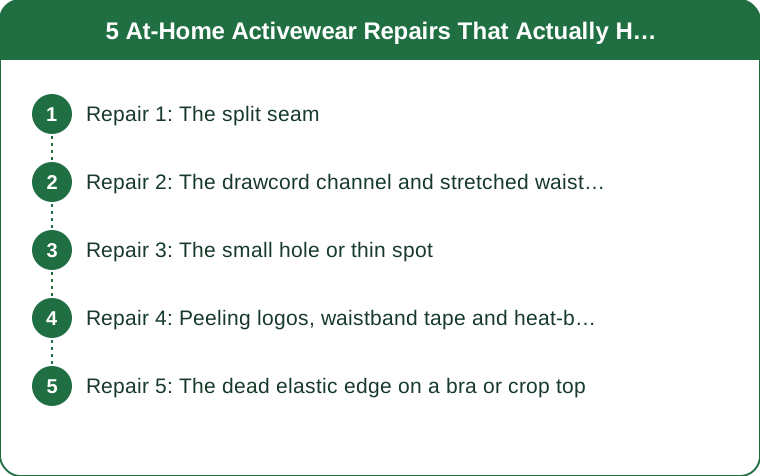
Repair 1: The split seam
This is the most common failure and the easiest win. A seam that has opened along the inner thigh or the back rise has usually failed at the thread, not the fabric - the fabric on either side is intact.
The technique. Turn the garment inside out. If you have a machine, use a narrow zigzag - roughly 2mm wide, 2.5mm long - and run it from about 2cm before the opening to 2cm past it, so you anchor into intact stitching on both ends. By hand, use a backstitch but leave the thread slightly slack every few stitches so the seam can extend.
Thread matters. Polyester thread, not cotton. Cotton has almost no stretch and it abrades quickly against synthetic fabric.
Why it holds. A zigzag has slack built into its geometry, so it can extend with the fabric instead of resisting it. A straight stitch is a rigid line across a material designed to grow 40 percent - it will break, and it will break in the same place.
Repair 2: The drawcord channel and stretched waistband
A waistband that has gone slack is usually not dead elastic - it is a drawcord that has pulled through, or a channel that has come unstitched at one edge and lost its tension.
Rethreading a lost drawcord. Attach a safety pin to one end and feed it through the channel, gathering and pushing the fabric along the pin rather than trying to pull the pin through. Five minutes, no sewing.
If the channel has opened, close it with the same narrow zigzag along the original stitch line, keeping the cord out of the way.
If the elastic itself is dead - it looks wavy, and it no longer springs back when stretched - you can insert a new length of 2cm knit elastic through the channel and secure both ends with a box of stitching. Cut it about 90 percent of your waist measurement so it has real tension.
Worth checking first: run the waistband under warm water and let it dry flat. Some apparent slackness is heat-relaxed fiber that partially recovers.

Repair 3: The small hole or thin spot
Thigh-rub holes, snags from a bike seat, and the thinning that shows up in the exact spot your phone sits in a pocket.
For a hole under about 1cm. Use a small piece of fusible knit interfacing on the inside - the stretch kind, not the woven kind - and press it with a low iron and a pressing cloth. Then zigzag over the hole itself in a couple of passes.
For a snag with no hole. Do not cut it. Push the pulled loop back through to the inside with a needle or a snag repair tool. Cutting turns a cosmetic problem into a structural one.
For a thin spot that is not through yet. Fusible knit interfacing on the inside alone, no stitching. It reinforces without adding a visible line, and it buys a genuinely long extension.
What will not work. Iron-on woven patches. They do not stretch, so the fabric around the patch takes all the strain and tears in a ring around the repair within a few wears.
Repair 4: Peeling logos, waistband tape and heat-bonded seams
Heat-bonded elements - printed logos, reflective strips, bonded seam tape - fail by delamination, and they look worse than they are.
The realistic assessment. Adhesive that has released will not permanently re-bond with a household iron. Occasional recommendations to press it flat give a result that lasts about two washes.
What actually works: remove it. Warm the edge gently with a hair dryer and peel the loose element off entirely. Most bonded logos leave a faint ghost that is invisible in wear. A garment with no logo is a garment you keep wearing.
For bonded seam tape that is peeling on the inside, remove the loose section and secure the seam underneath with a narrow zigzag. The tape was there for comfort and water resistance, not structural integrity, in most everyday activewear.
When to stop. If the bonded element is holding the seam itself - common on some waterproof shells - this becomes a repair shop job rather than a kitchen table job.
Repair 5: The dead elastic edge on a bra or crop top
The band edge on a sports bra goes first, and it goes long before the rest of the garment does.
Diagnose it properly. Stretch the band and release it. If it returns fully, it is fine and the fit issue is elsewhere. If it returns slowly or stays wavy, the elastic is done.
The replacement. Unpick roughly 5cm of the band casing, pull out a length of the old elastic, cut new 2 to 2.5cm plush-back elastic to about 90 percent of the old length, and safety-pin it through. Overlap the ends by 1cm and stitch a small box through both layers, then close the casing with a zigzag.
Time and cost. About 25 minutes the first time, 12 after that, and roughly two dollars of elastic against a $50 replacement.
The honest limit. If the fabric itself has gone translucent or the cups have permanently distorted, replacing the elastic gives you a well-fitting worn-out bra. Elastic replacement extends the life of a garment that is otherwise sound - it does not resurrect one that is finished.
TL;DR:
- Almost all failed home repairs on activewear come from using a stitch that cannot stretch - use a narrow zigzag or a loose backstitch with polyester thread.
- Split seams, lost drawcords and small holes are 10 to 15 minute fixes with a very high success rate.
- Peeling logos and bonded tape are best removed cleanly rather than re-bonded.
- Replacing band elastic costs about two dollars and adds a season or more to a sports bra that is otherwise sound.
The environmental math here is unglamorous and very good: the lowest-impact garment is almost always the one already in your drawer, and five repair techniques cover the overwhelming majority of reasons it would otherwise leave.
See It in Motion
Seen here: Racerback Tank Top - White — shop similar styles on bubblelime.com
Keep Reading
This article is for general informational and styling purposes only. Fit, sizing, and product availability may vary.