Can Old Activewear Actually Be Recycled, or Does It Just End Up in Landfill Anyway?
Quick Answer: Most activewear is made from blended synthetic fabrics (polyester-spandex, nylon-spandex), and blended fabrics are significantly harder to recycle than single-material textiles because current recycling technology struggles to separate fiber blends efficiently — some genuine recycling does happen through specialized programs, but a meaningful portion of ‘recycled’ activewear still ends up downcycled into lower-value products or landfilled, so it’s worth being realistic about what a recycling bin actually accomplishes.
Activewear recycling isn’t a myth, but it’s also not the clean closed loop that most donation-bin marketing implies, and knowing the difference changes how much to rely on it as a sustainability solution.
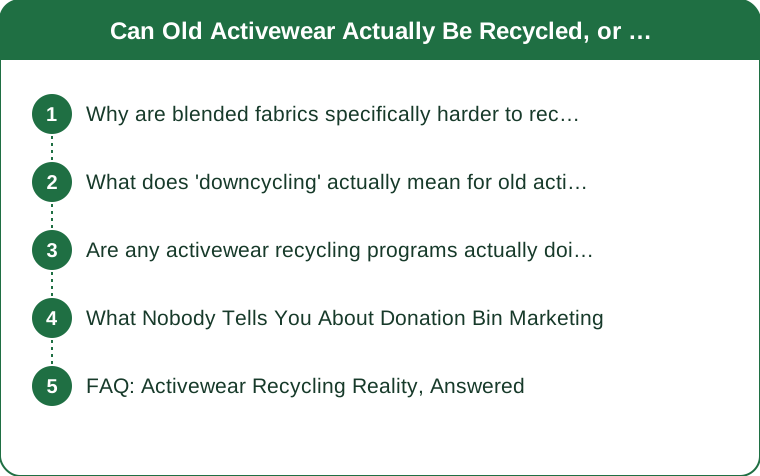
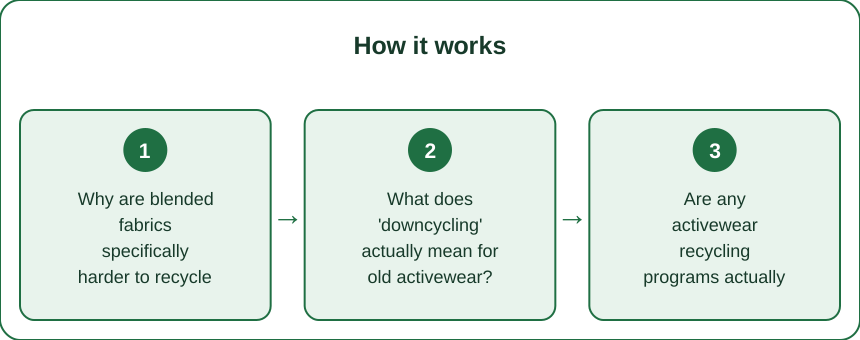
Why are blended fabrics specifically harder to recycle than something like cotton?
Recycling processes generally work best on single-material textiles that can be broken down and reprocessed uniformly, while a poly-spandex blend requires separating two different fiber types before either can be effectively reprocessed, a separation process that’s technically difficult and not widely available at scale yet.
What does ‘downcycling’ actually mean for old activewear?
Downcycling means the material is repurposed into a lower-value product — insulation material, industrial rags, carpet padding — rather than being turned back into new activewear-grade fabric, which is a legitimate way to keep material out of landfill but isn’t the same closed-loop recycling that terms like ‘recycled fabric’ sometimes imply.
Are any activewear recycling programs actually doing full fiber-to-fiber recycling?
A small but growing number of specialized programs and brand-specific take-back initiatives are working on genuine fiber-to-fiber recycling technology, though this remains a limited-scale solution rather than the default outcome for most donated or recycled activewear today.
What Nobody Tells You About Donation Bin Marketing
Nobody tells you that a ‘recycle your old activewear here’ bin doesn’t guarantee fiber-to-fiber recycling happens — it more often means the item enters a broader textile-sorting stream where downcycling or, in some cases, landfill disposal remains a real possible outcome depending on the specific program and fabric composition.
FAQ: Activewear Recycling Reality, Answered
Is there a way to check whether a specific brand’s take-back program does genuine fiber recycling?
Checking a brand’s sustainability report or directly asking customer service about their specific recycling partner and process is more reliable than assuming based on marketing language alone.
Does donating still-wearable activewear avoid this recycling uncertainty entirely?
Yes, donating items still in usable condition for resale or reuse is generally a more certain positive outcome than sending worn-out items into a recycling stream with uncertain results.
Is buying higher-spandex-content activewear worse for eventual recyclability?
Generally yes, since a higher blend complexity makes fiber separation even more difficult, though this has to be weighed against the performance benefits that spandex content provides during actual use.
TL;DR:
- Blended synthetic fabrics are significantly harder to recycle than single-material textiles
- Downcycling into lower-value products is a common outcome, not full fiber-to-fiber recycling
- Genuine fiber recycling technology exists but remains limited in scale
- Donating still-wearable pieces is a more certain positive outcome than recycling worn-out ones
Activewear recycling is real but limited — treating it as one part of a broader approach, rather than a guaranteed clean solution, is the more realistic way to think about it.
See It in Motion
Seen here: High Waist Embossed Yoga Leggings with Side Pockets — shop it on bubblelime.com
Keep Reading
This article is for general informational and styling purposes only. Fit, sizing, and product availability may vary.